The Solution: Resilient, Internal Price Prediction
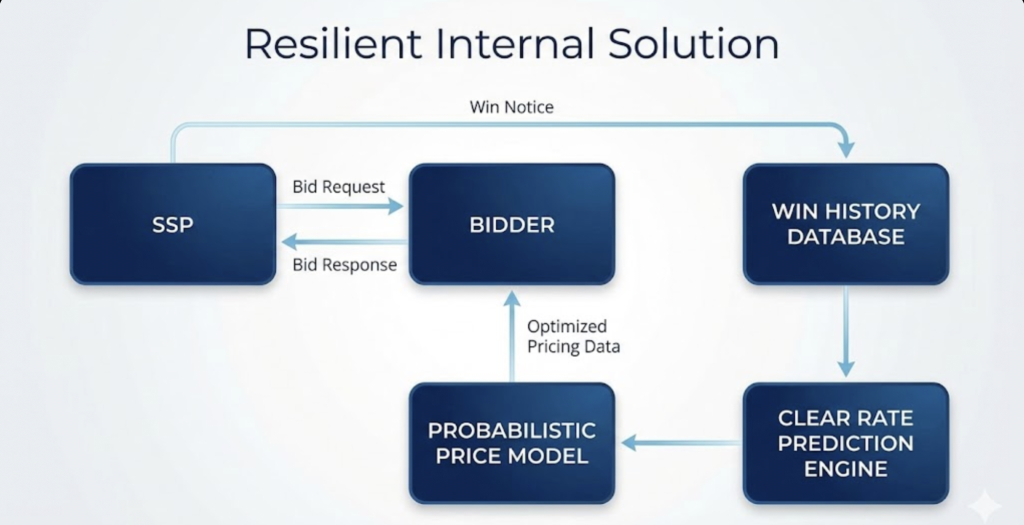
We refused to build a pricing engine dependent on dirty external data. Instead, we built a resilient, self-reliant system based on a single, irrefutable truth: our own winning history.
By ingesting and analyzing every successful win in real-time, our system builds a powerful internal dataset. Our Price Prediction Engine uses this historical data to model the probability of winning at different price points for specific inventory. This allows us to generate a dynamic, probabilistic price model that knows the exact statistical “floor” required to win-no more, no less.
Below is a diagram illustrating the fundamental architectural shift from a fragile, externally-dependent loop to a robust, internal one.
The Result: A Probabilistic Model for Optimal Bidding
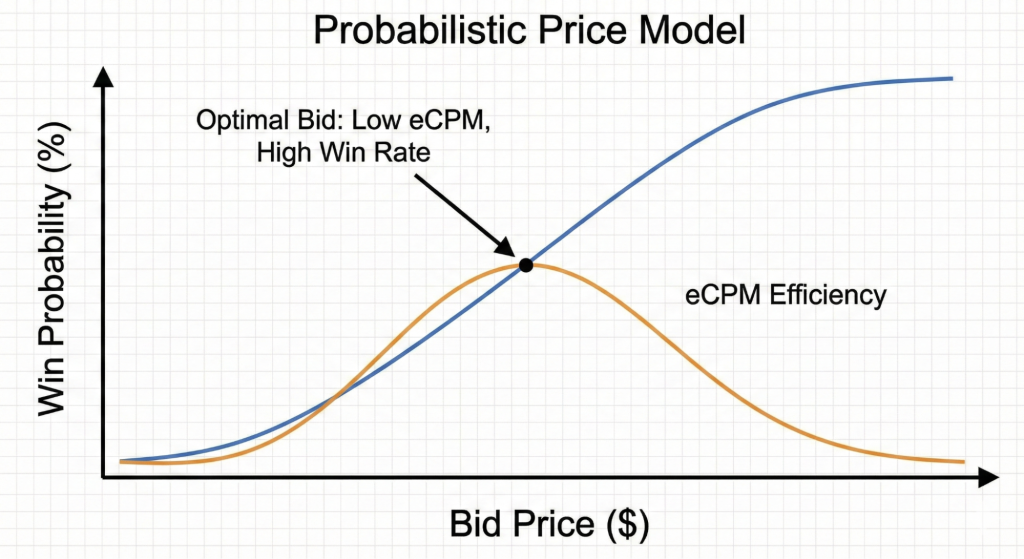
The output of this system is a sophisticated Probabilistic Price Model. This model doesn’t just give a single price; it provides a curve showing the relationship between bid price and win probability.
By analyzing this curve, our bidder can intelligently select the optimal bid. It identifies the point where the win probability is high enough to secure the impression, but the bid price is low enough to maximize eCPM efficiency. The result is a “smart” bid that wins the auction without overpaying.
The Business Impact: Optimal eCPM for Advertisers
This isn’t just an interesting engineering challenge; it has a direct, measurable impact on our clients’ bottom line. By moving to a statistically driven, self-tuning bidder, we deliver three key benefits:
- Optimal eCPM: By accurately predicting the clearing price, we prevent overbidding. Every dollar saved is reinvested into the campaign, allowing advertisers to win more impressions and drive more conversions with the same budget.
- Resilient Campaign Delivery: Our pricing models don’t break when an SSP’s infrastructure has a bad day. Because we rely on our own robust win data, campaigns pace smoothly and consistently regardless of external factors.
- Maximum Win Rates on Premium Inventory: When a highly valuable impression becomes available, our model instantly knows the historical price required to win it, ensuring we don’t miss opportunities by underbidding on quality users.
At GeoSpot, we believe that high-performance engineering isn’t just about raw speed. It’s about building intelligent, resilient systems that turn technical complexity into a competitive advantage for our partners.

Post Comment